A Reference Architecture for Independent Evidence Reinforcement and Risk-Governed Adaptive Resilience
Abstract
Modern systems are very good at producing signals. Logs, traces, metrics, health checks, browser telemetry, service errors, infrastructure events, and anomaly detectors can tell us that something unusual is happening. But there is a subtle problem hidden inside all of that data: more signals do not always mean more evidence.
Ten thousand identical failures from one process trapped in a retry loop may tell us less than fifty matching observations coming independently from different applications, regions, runtimes, and infrastructure paths.
SHIELD is an architecture model I am exploring around that distinction. It treats evidence independence, diversity, correlation, reinforcement, and decay as first-class inputs to collective confidence. It then separates that confidence from a second question: how much remediation authority should the system receive?
The central principle is: confidence should grow with independent corroboration, not raw repetition; remediation authority should grow only when confidence and operational safety justify it.
It Started With Ants
The idea started in a place I was not expecting: a dead cockroach.
I noticed one on the floor. Some time later, ants had gathered around it. My first thought was simple: how did they know it was there?
An ant does not need a central command center telling the colony where food has appeared. A scout encounters something useful and leaves a chemical signal. Other ants encounter that signal, follow it, and reinforce the trail. The environment itself becomes part of the coordination mechanism.
That behavior is known as stigmergy, and it is not new to computer science. Nature-inspired coordination, digital pheromones, swarm systems, autonomic computing, anomaly detection, and self-healing architectures all have substantial histories.
But the observation led me to a different software question:
What if a distributed system became more confident about a failure not because the same error happened many times, but because genuinely independent parts of the system kept arriving at the same conclusion?
The Problem With Counting Errors
Consider two incidents.
In the first, a single application instance reports the same timeout 10,000 times. The requests come through the same network path, use the same runtime, hit the same dependency, and may even be generated by the same retry loop.
In the second, only fifty failures occur. But they are observed across twelve applications, multiple infrastructure nodes, several regions, different runtime technologies, and unrelated user sessions. The failures share the same underlying fingerprint.
Which is stronger evidence of a systemic problem?
Raw event counting naturally favors the first incident. SHIELD is designed to recognize why the second may deserve substantially greater confidence.
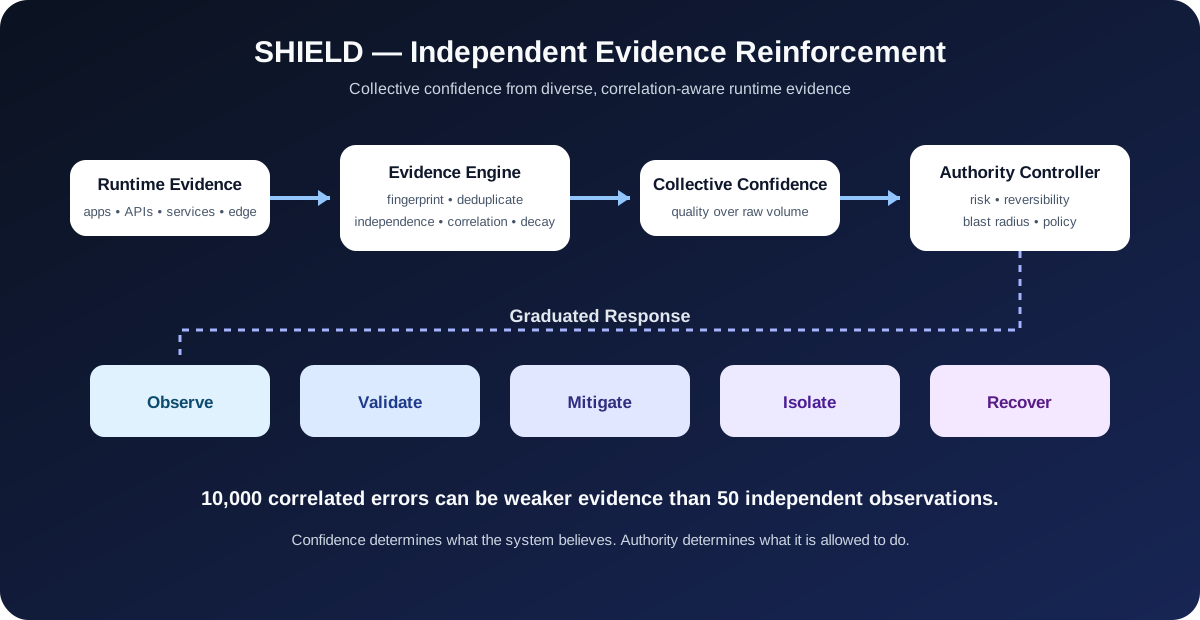
10,000 correlated errors can be weaker evidence than 50 independent observations.
Formal Definition
SHIELD is a distributed resilience architecture in which runtime observations are treated as evidence signals that are fingerprinted, deduplicated, evaluated for independence and correlation, reinforced by diverse corroboration, decayed over time, and converted into collective confidence before risk-governed remediation authority is granted.
SHIELD does not require a particular cloud, programming language, application framework, monitoring product, or deployment topology.
SHIELD Quick Reference
If you remember only two things from this model, remember these:
Confidence is about what the system believes. Authority is about what the system is allowed to do.
- Evidence — runtime observations are clues, not automatic incidents.
- Independence — repeated observations from the same causal source should not masquerade as independent confirmation.
- Reinforcement — diverse corroborating evidence increases confidence.
- Decay — stale evidence gradually loses influence when the condition disappears.
- Authority — remediation depends on confidence, reversibility, blast radius, policy, and safety.
Evidence, Not Just Events
A SHIELD participant can be almost anything capable of observing runtime behavior: a web application, mobile app, API, microservice, container, serverless function, Kubernetes workload, edge process, database monitor, infrastructure agent, or IoT device.
Each participant contributes an evidence signal. A signal might describe a dependency timeout, render failure, authentication problem, data inconsistency, resource exhaustion condition, or another observable symptom.
The important distinction is that a signal is neither an incident nor a command to remediate. It is evidence that must be evaluated in context.
Independent Evidence Reinforcement
This is the architectural center of SHIELD.
Suppose one process emits the same failure 500 times. That is useful information about frequency and impact, but it should not automatically be interpreted as 500 independent confirmations.
SHIELD instead asks questions such as:
- How many independent applications observed the condition?
- Did observations come from different runtime instances?
- Are they distributed across regions or availability zones?
- Do they span unrelated sessions or tenants?
- Are multiple versions affected?
- Do the observations share an infrastructure or network dependency that makes them correlated?
The objective is not to count reporters. It is to estimate how much new information each reporter contributes.
Correlation Must Reduce Confidence Gain
Multiple sources can appear independent while sharing the same cause. Five applications may all fail because they traverse one unhealthy gateway. A thousand browser sessions may all be affected by one bad deployment. Fifty services may ultimately depend on the same database.
SHIELD therefore introduces a correlation penalty. Evidence that shares causal infrastructure, deployment lineage, retry behavior, dependency paths, or other common factors should contribute less additional confidence than truly independent corroboration.
A simplified conceptual relationship is:
Effective Evidence = Observed Evidence × Independence × Diversity × Correlation Adjustment × Temporal Weight
This is deliberately a model rather than a fixed equation. One of the next steps for SHIELD is to test different formulations experimentally.
Evidence Should Fade
Ant trails disappear when they are no longer reinforced. Software evidence should have a similar property.
If a transient network problem generates evidence for thirty seconds and never appears again, that evidence should not permanently influence the system's confidence. SHIELD therefore allows evidence to decay over time.
Different conditions may decay at different rates. A transient timeout may lose relevance quickly. Evidence suggesting persistent corruption or a security-sensitive condition may decay much more slowly.
Reinforcement and decay together allow confidence to behave like a living assessment of current conditions rather than a lifetime counter.
Collective Confidence
After fingerprinting, deduplication, independence analysis, correlation adjustment, diversity assessment, and temporal weighting, SHIELD produces a collective confidence value.
Conceptually:
C = f(independence, diversity, temporal concentration, fingerprint agreement, recurrence, source reliability, correlation, decay)
The important point is not the exact formula. The important point is what the formula refuses to assume: volume is not the same thing as confidence.
Confidence Is Not Severity
SHIELD also separates confidence from impact.
The system may be 99 percent confident that an internal logging component is unavailable while the business impact is negligible. It may be only 65 percent confident that customer payments are being duplicated while the potential consequence is severe.
Those situations should not produce identical responses.
From Confidence to Remediation Authority
This leads to the second half of SHIELD.
A system can be extremely confident about what is wrong and still not have enough justification to perform a dangerous autonomous action.
For example, increasing telemetry is highly reversible. Routing traffic away from an unhealthy instance is usually reversible. Disabling a feature may have a larger impact. Deleting data is a completely different category of action.
SHIELD therefore separates Collective Confidence from Remediation Authority.
A conceptual authority model can consider:
Authority = f(confidence, independence, reversibility, blast radius, safety, policy)
This produces graduated responses rather than a single automation threshold.
Graduated Response
A SHIELD implementation might move through levels such as:
- Observe — record the evidence without intervention.
- Enrich — temporarily increase diagnostics or telemetry.
- Validate — seek additional independent confirmation.
- Mitigate — apply a safe local fallback or traffic adjustment.
- Isolate — circuit-break or quarantine the suspected component.
- Recover — perform controlled rollback, failover, or another approved recovery action.
The exact levels are implementation choices. The architectural requirement is that stronger intervention requires stronger justification.
What SHIELD Is Not
SHIELD is not intended to replace observability platforms, anomaly detection, incident management, service meshes, circuit breakers, SRE practices, orchestration systems, or existing self-healing mechanisms.
Those systems can provide observations and execute responses.
SHIELD focuses on the decision layer between them: how distributed observations become trustworthy collective evidence, and how that evidence influences the authority to intervene.
It is also not simply "digital pheromones for software." Reinforcement and decay are useful inspirations, but the differentiating question I am exploring is how independence and correlation of evidence should affect confidence and remediation authority.
How SHIELD Relates to AEG
SHIELD and the Agentic–Event–Governed (AEG) Architecture Model address different problems and neither depends on the other.
SHIELD asks: What does the distributed system have enough independent evidence to believe?
AEG asks: When autonomous intelligence proposes an action, who or what has authority to let that intent become execution?
A system could use SHIELD without AI agents at all. Likewise, an AEG system does not require SHIELD. But they can compose naturally: SHIELD can provide evidence and confidence as context to an AEG-governed decision, while AEG can provide an independent governance boundary before an autonomous remediation action is executed.
A Concrete Example
Imagine an API dependency begins failing.
At first, one service reports several timeouts. SHIELD records the evidence but assigns limited confidence because the observations come from one source.
A second service in the same cluster reports the failure. Confidence increases slightly, but correlation remains high.
Then independent applications in two other regions, using different runtime stacks and infrastructure paths, begin reporting the same dependency fingerprint. The evidence becomes substantially stronger even though the total event count remains relatively small.
SHIELD raises collective confidence. A safe mitigation, such as temporarily routing traffic to a healthy endpoint, may now receive sufficient authority. A destructive remediation would still require a much higher safety bar or explicit governance approval.
If the failures stop, the evidence decays and confidence falls naturally.
What Still Needs to Be Proven
SHIELD is an architecture model under active exploration, not a claim that every mechanism described here is individually new. Stigmergy, distributed failure detection, confidence models, autonomic computing, anomaly detection, and automated remediation all have substantial prior work.
The research question I want to test is narrower:
Can correlation-aware independent evidence reinforcement reduce false confidence while allowing distributed failures to be recognized early enough for safe, graduated remediation?
That needs experiments, not just diagrams.
Where I Am Taking This Next
The next step is to build a small platform-independent reference implementation and compare SHIELD against conventional event-count and threshold-based detection.
The first experiment is intentionally simple: generate 10,000 highly correlated failures and compare them with a much smaller set of genuinely independent matching observations. Then measure how quickly each detection model converges, how often it produces false positives, and what happens as evidence decays.
I plan to document the architecture, experiments, results, and failures as the model evolves.
Because the interesting part of the idea is not that ants can find a cockroach.
It is the possibility that software systems could learn to distinguish repetition from independent agreement—and become safer about when they act on what they believe.
How to Reference This Model
Jacob George. The SHIELD Architecture Model: Independent Evidence Reinforcement for Adaptive Resilience. jacobpallattu.com, 2026. Canonical reference: /architecture/shield.